
Complete CS2 Economy Guide: Rewards, Buys & Tips
You know the game.
You’re broke, tilted, and the thought of another eco round feels like giving up.
Logic says save, but your gut screams force buy. So you grab a Deagle or a MAC-10, hoping your aim can somehow bridge the gap against AKs and full armor. Maybe you snag a kill and steal an AK, and win the round.
But let’s be real, most of the time it doesn’t happen. The weapon gap is just too big, and that one desperate force buy is exactly what turns a close game into a loss.
That’s why understanding the CS2 economy isn’t optional for high elo players, it’s the difference between playing smart and throwing away good odds. Losing a round doesn’t mean losing the match. The teams that think long-term, manage their money, and pick their battles wisely are the ones that actually close out games.
What's The Meaning of Economy?
After the end of each round, all players receive different amounts of money to buy weapons and utility for the next round. Using that money wisely ensures that you have money for every round that you play.
Similarly, wasting it on low-use items destroys your economy – and you're frequently forced to have an eco round. That can affect the team's momentum, ability to fight, and map control tempo.
Here are all the factors that affect the money that’s earned.
- Round Result (Win or Loss)
- Kills
- Plant / Defuse
Match Outcome Rewards
The numbers slightly differ if you switch from the Competitive mode to Wingman or Hostage, but we will address the latter two a bit later. For now, let's focus on the Competitive and Premier Modes.
In all modes, players start with $800 ($1,000 for Casual Mode) and earn their way up. And it is only logical that winning a round gives your team a higher reward than losing, but how does it work? This CS2 economy chart explains everything perfectly:
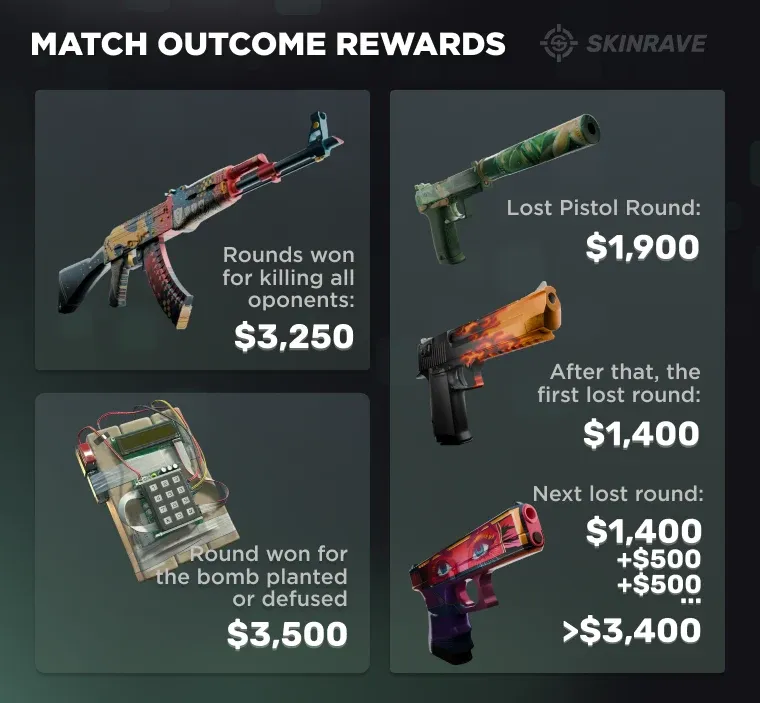
- Winning a round: $3,250
- Winning after a successful plant/ defuse: $3,500
- Losing a pistol round: $1,900
- First loss after the pistol round: $1,400
- Streak of losses: $1400 + $500 * Rounds Lost (Max $3,400)
- Losing with a time-out (for Ts): $0
- Bomb bonuses: T planter $300, T team on loss after plant $600, CT defuser $300.
The maximum amount of many a single player is allowed to have is $16,000.
And as kills also have significant value in the economy, we need to dive deeper to fully understand how it works.
Kill Rewards
In the recent CS2 update (July 16 2025), all CTs receive $50 for each killed Terrorist. This was added to the game to slightly improve the fragile economy of CTs. After this update, a lot of players hunt down the Ts, even if the victory was secured with a defuse.
Different weapons give different rewards, depending on the difficulty of killing an enemy with them. (All rewards are given per kill)
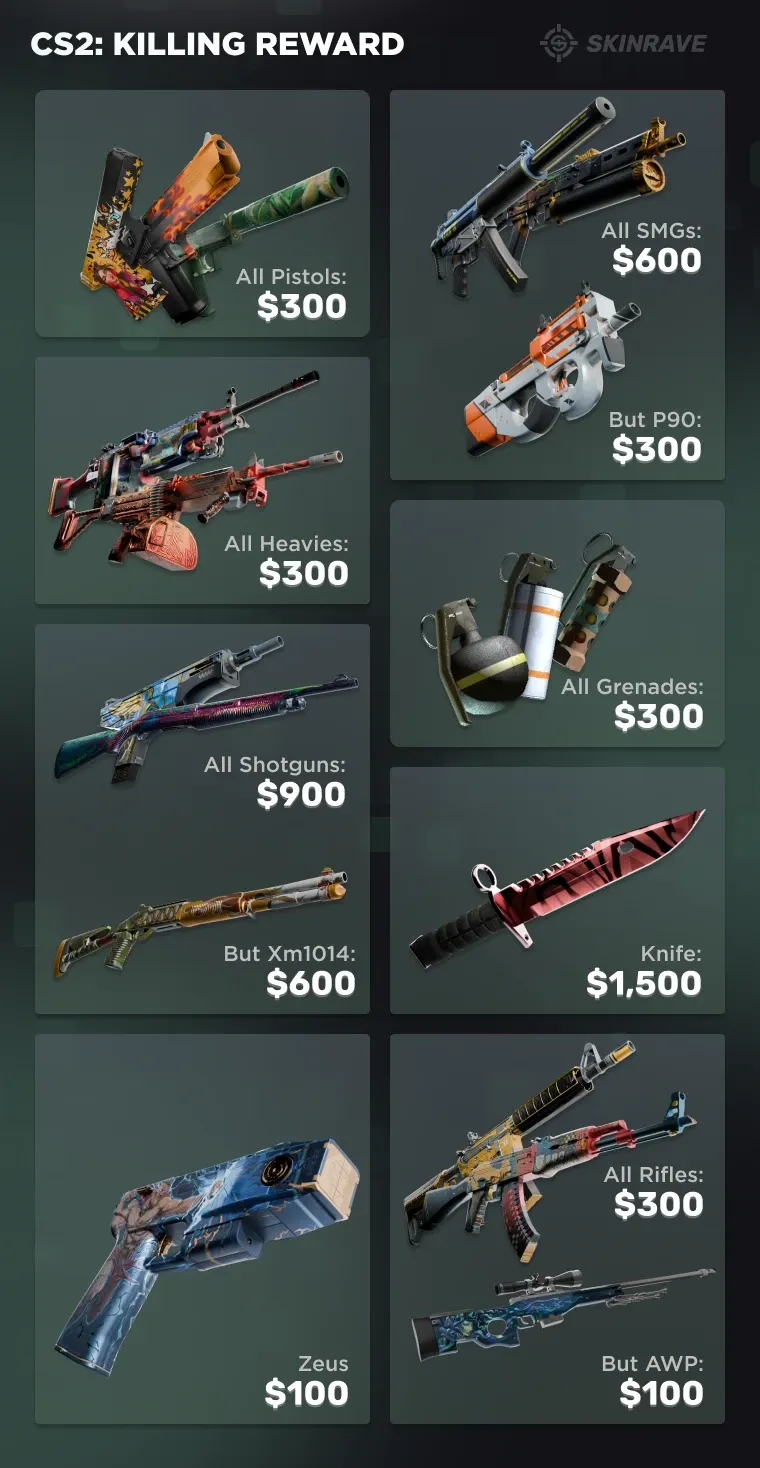
- All pistols: $300
- All SMGs (without P90): $600
- P90: $300
- All Heavies: $300
- All Grenades: $300
- All Shotguns (without XM1014): $900
- XM1014: $600
- Knife: $1,500
- All Rifles: $300
- AWP: $100
- Zeus: $100
Killing your teammate deducts $300 from your balance.
Also, in CS2's Casual mode, the kill rewards are split in half.
Valve constantly changes and improves the reward system to maximally balance the game. This chart of rewards helps you decide which weapon to buy on each round – that is, which strategy to use.
Economy Strategies
There are several strategies that a lot of casual and pro players use during their matches. They aim to improve the economic situation depending on its condition, or help you decide what to buy if your economy looks good. Here's all the info you need.
Full Buy
During a full buy round, each player in a team has more than $5,000 and can buy the best weapons available, armor, + utility. The Full Buy round gives your team its best chances at winning, as the whole team has everything it needs for its best performance.
Force Buy
During a Force Buy round, teams spend all the money they have trying to buy the best weapons for the given amount. Despite creating a risk of losing and being forced to have an Eco round next, it gives your team pretty good chances to win.
You may fall short on some grenades or a helmet, but at least you have a weapon that has a high potential of getting a kill.
Half-Buy
The Half-Buy rounds mean that your team's economy is unstable, and you spend only half of your money to be able to Full Buy in the following round.
People in these rounds usually gear up with cheaper Rifles, SMGs, and maybe a few grenades. Not only does this lower the expenses, but also gives your team decent weapons to play with.
Eco Round
This is the worst-case scenario of all: your team has no money to buy normal weapons. It’s the round where the whole team doesn't buy anything, or only upgrades the pistols.
Winning an Eco round is really hard, but not impossible. But remember that your main goal here is to get as many kills as possible and take your enemies' weapons with you.
Despite the result of the match, your team will earn some money to buy up in the next round.
Save Round
Players usually do Save Rounds when the economy is somewhat good and they have expensive weapons such as the AWP. They just avoid any fight with the opponents, giving them the round for the sake of not losing the weapon(s).
Although you lose one round, you create a bigger possibility of overthrowing the enemies in the following matches.
Hero Buy
Hero Buy rounds are similar to Eco rounds, but with a difference that one teammate buys a superior weapon. While the whole team does an Eco, the sniper buys an AWP or an SSG 08. With that logic, he becomes the "hero" of the team that's supposed to get as many kills as possible.
Anti-Eco / Farming
Anti-Eco rounds are risky but extremely rewarding. If you calculate that your opponents are forced to have an eco, your team can buy high-reward weapons, such as Shotguns or SMGs, to get easy kills and farm money.
The risky part is that you don't know exactly what the enemy team will buy. They might do a Force Buy and be a good competition in the round.
Wingman Mode Economy
We already mentioned that the Wingman mode follows a similar logic, which differs only in numbers. As the mode has only 2 players per team, the rewards are lower than for the 5vs5 modes. Here's everything that's worth remembering:
The $800 bonus for the Terrorists is given if they lose, but the bomb was planted.
Maximum amount of cash here is $8,000.
Hostage Mode Economy
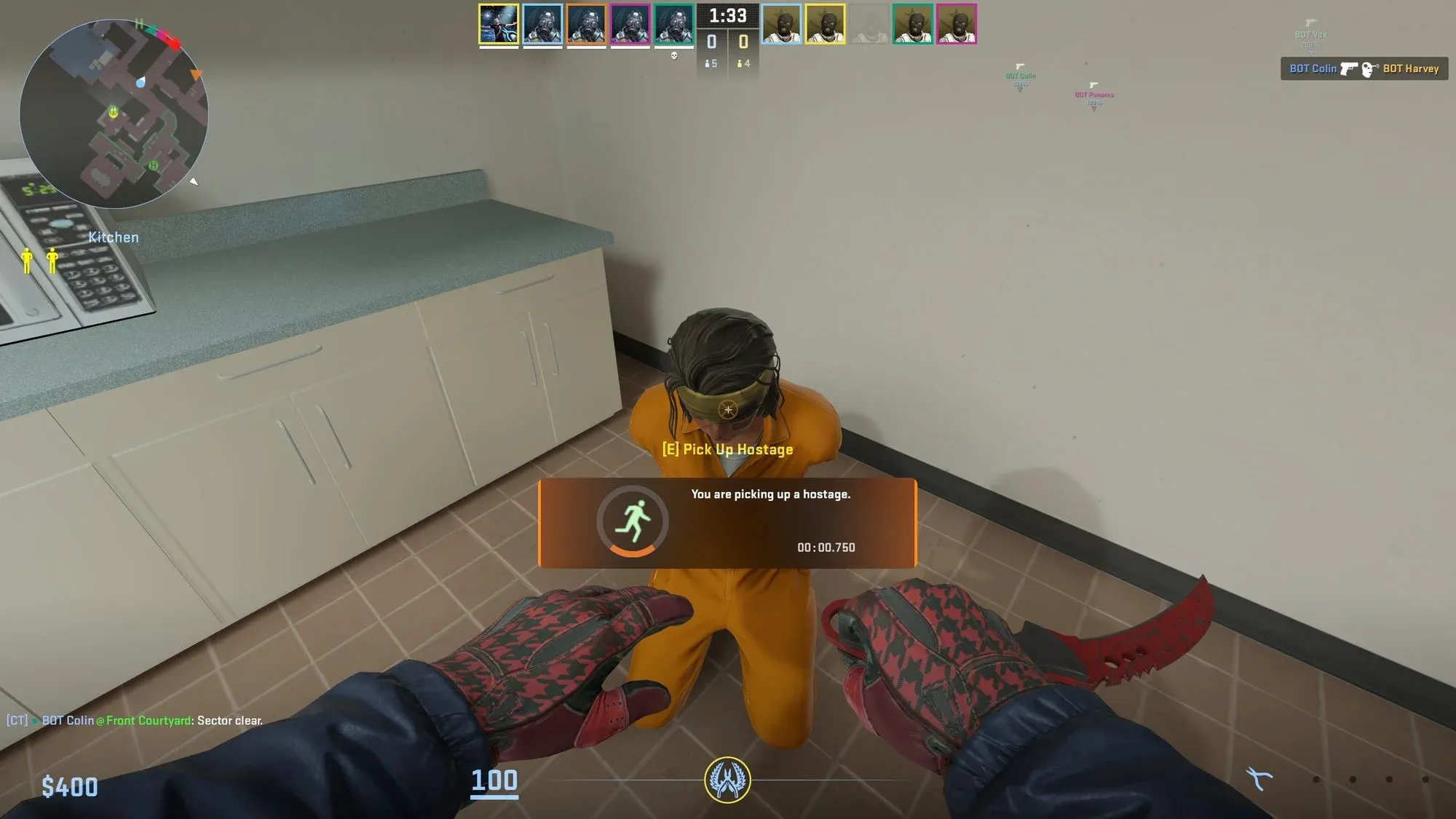
The reward amounts for the Hostage Mode are also a bit different. As there’s no bomb, there are no bonuses associated with it. However, similar to its logic, the team gets bonuses for picking up and rescuing the hostage.
Hostage cash events: The pickup ($300+$600 team) and rescue ($1000+$600 team).
CTs win by rescuing the hostage: $2,900.
Ts win by elimination: $3,000.
Ts win because of a time-out: $3,250.
Hostage mode is interesting, as it switches the objectives of the teams – Ts try to protect sites, while CTs attack.
Helpful Tips
A lot of new players make mistakes out of inexperience that hurt the team's economy. To avoid them, check out this list of helpful tips.
- Make good decisions. Don't overspend your money on low-efficiency items like the Zeus x27. You can do that in the final rounds, when saving money is meaningless.
- Always plan ahead. If you Force Buy every round, it's gonna kill your economy, and consequently, your performance.
- Always plant. Even if you won the round, plant the bomb for the extra money. $300 can buy you a better pistol or some utility.
- Buy-up in the end. In the final rounds, buy the best weapons that you can, with maximum utility and side weapons. A better pistol might become handy.
- Remember to drop. If you have additional money and your teammate has economy problems, drop him a weapon and help him recover his situation.
- Reward Calculators. To better understand the logic, you can use CS2 economy calculators that have all the up-to-date information for reward calculations.
Final Words
Always remember that managing the economy is not a one-player responsibility – it's the whole team's responsibility. If one teammate always Force Buys, his actions may hurt the others and ultimately bring the team to a loss.
Always communicate about the buying decisions with your team and try to predict what the other team might do. With experience, you'll be able to do everything in your mind or even with your intuition.