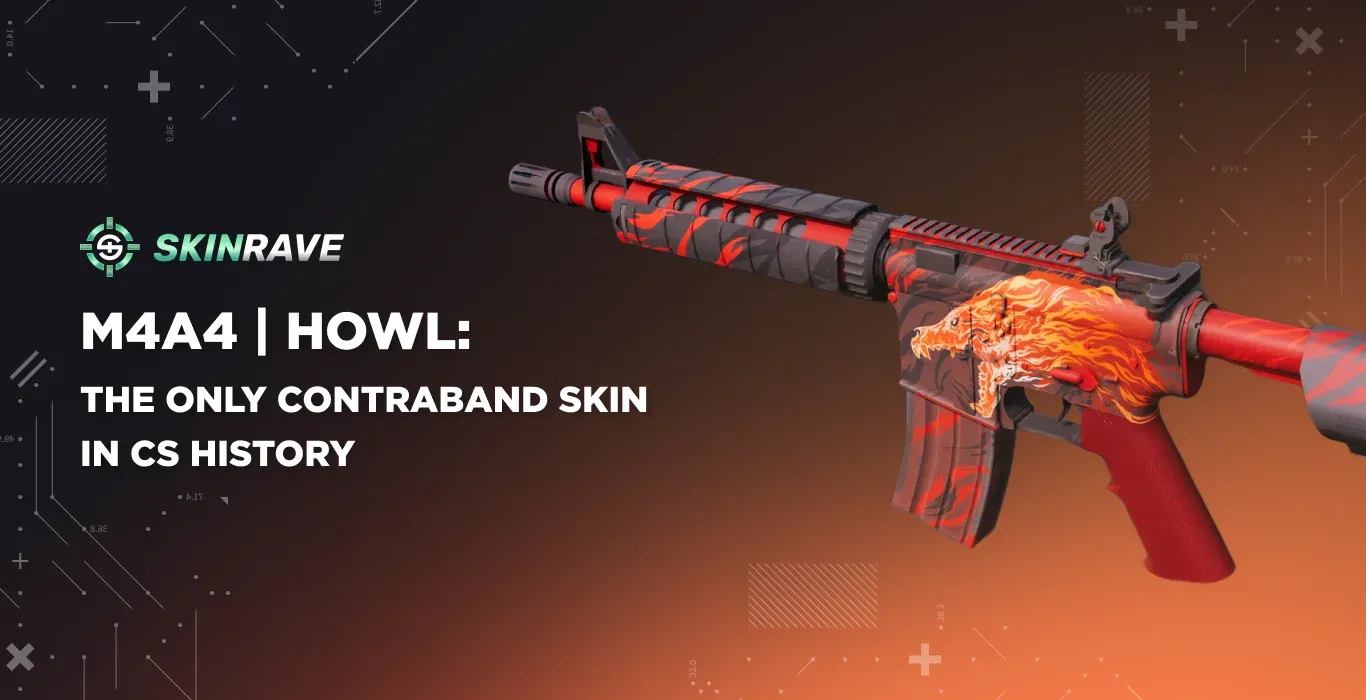
M4A4 | Howl: The Only Contraband Skin in CS History
What gives a digital item its value? Scarcity? Aesthetic appeal? Utility? In many cases, it’s a mix of these.
But for Counter-Strike’s M4A4 | Howl, the value comes from something far rarer: its story.
This weapon skin, now worth tens of thousands of dollars, derives its legendary status from being a digital paradox: an object that shouldn't exist, born from theft, legitimized through corporate creativity, and transformed into an unrepeatable piece of gaming history.
What is a contraband skin in CS?
Contraband is an exclusive and exceptionally rare weapon skin rarity in Counter-Strike, created for a single item that was removed from its case due to a major copyright infringement issue. To date, there is only one skin with this classification: The M4A4 | Howl.
Even if other skins were later changed due to copyright issues, Valve chose not to repeat the "Contraband" classification to avoid creating a perverse incentive for fraud and causing severe market instability.
By making the M4A4 | Howl a super-rare and valuable "Contraband" item, Valve inadvertently created a blueprint for exploitation. If they continued this practice, it would encourage bad actors to intentionally submit stolen artwork to the Workshop.
For subsequent copyright infringements, such as with the M4A4 | Griffin or the AWP | Doodle Lore, Valve's approach was to completely remove the infringing skin and replace it in players' inventories with an entirely new skin of the same rarity.
Why is M4 Howl contraband? The story

By early 2014, Valve’s Steam Workshop had become a buzzing hub for community-made creations. The idea was simple: artists designed weapon skins, the community voted for their favorites, and Valve picked the standouts to add into the game. If your skin made it in, you’d get a cut of the revenue.
It was in this environment that two Steam users "Auzzii" and "sic" submitted a striking weapon skin design to the CS:GO Workshop. The "Howling Dawn" featured a fierce wolf's head engulfed in vibrant flames, an aesthetic that immediately captivated the community. Auzzii even claimed that the artwork was inspired by a photo of his own dog, adding a personal touch that helped the submission gather over 4,000 positive votes.
The community loved it. The skin racked up over 4,000 positive votes, and Valve took notice. Just over a month later, on May 1, 2014, it made its official debut in CS:GO’s The Hunt Begins update. Rebranded as the M4A4 | Howl, and was placed in the brand-new Huntsman Weapon Case as a Covert (red) rarity, instantly making it one of the most sought-after skins in that case.
The Fall
The Howl's legitimacy lasted less than a month. In June 2014, DeviantArt artist CanisAlbus discovered that his artwork "Aggression" had been stolen and commercialized without permission. The supposed photo of Auzzii's dog was a complete fabrication, the design was lifted directly from CanisAlbus's original creation.
CanisAlbus went public with a scathing DeviantArt post titled "Art theft in Steam/Counter-Strike," complete with side-by-side comparisons that left no doubt about the plagiarism. More importantly, he filed a formal DMCA takedown notice with Valve, transforming a community controversy into a serious legal matter that demanded immediate action.
The Birth of the Contraband

Valve's response was swift and unprecedented. On June 12, 2014, the company issued a statement titled "Respecting Intellectual Property," outlining their multi-faceted solution to the crisis.
First came punishment: Auzzii and sic received permanent Steam Community bans and were stripped of all proceeds from the Howl's sales. All their other Workshop items were removed from the game entirely.
But the real genius lay in how Valve handled the thousands of Howls already in players' inventories.
Rather than delete purchased items and risk massive backlash, Valve's internal art team created a redesigned version, similar enough to maintain continuity but legally distinct from the stolen art.
The new design featured a more abstract, stylized creature that some players even compared to a lizard rather than a traditional wolf. The color palette also changed, with Valve's version including more orange and yellow in the flames, and the weapon's grip changing from black to orange.
Then came the decision that would transform the Howl from scandal to legend. Valve permanently removed it from the Huntsman Case and all drop tables, then assigned every existing Howl a brand-new item quality: "Contraband," marked by distinctive yellow-gold text. The supply was now frozen forever. No new Howls would ever enter circulation again. The M4A4 | Howl became, and remains to this day, the only Contraband weapon skin in Counter-Strike.
This unprecedented move transformed the M4A4 | Howl into Counter-Strike's most valuable commodity. With supply permanently capped at an estimated 7,383 units and ever-growing demand, prices exploded. What once cost players the price of a case and key now commands thousands of dollars for common versions and up to even six figures for the rarest StatTrak™ Factory New variants.
Never to Be Repeated
While other Workshop copyright disputes have emerged since, like the M4A4 | Griffin and AWP | Doodle Lore, Valve has never created another Contraband item. These later cases were resolved through simple redesigns or inventory replacements, showing that Valve learned from the economic chaos the Howl created. The company clearly decided that while the Contraband solution worked once, it set a dangerous precedent they wouldn't repeat.
Today, the M4A4 | Howl stands alone as Counter-Strike's only Contraband weapon skin, a permanent reminder of what happens when art theft, legal action, and creative problem-solving collide in the digital age.